Quick summary: Choosing a business phone system in Ireland means cutting through a lot of near-identical marketing terms — cloud PBX, hosted VoIP, UCaaS — to find a provider that actually fits how Irish businesses operate: local numbers, EU-hosted data, and support during Irish hours. This guide covers the real distinctions that matter, what to check before signing up, and how Dromlik, a cloud phone system built specifically for Irish SMBs, compares on each point.
See Dromlik in action
Free 7-day trial, no setup fees, free number porting.
If you’re shopping for a business phone system in Ireland, the market looks crowded. Cloud PBX, hosted VoIP, UCaaS, omnichannel — the terminology alone is enough to make you close the tab and stick with what you have.
This guide cuts through it. We’ll cover what the different types of phone systems actually mean, what Irish businesses specifically need to watch out for, and how to make a decision you won’t regret six months in.
On-Premise vs Cloud: The Only Distinction That Matters
There are two fundamental types of business phone system, and the choice between them shapes everything else.
On-Premise Hardware installed at your office that manages your internal phone network. Was the standard for decades. Still found in larger organisations with legacy infrastructure. For most Irish SMBs looking at a new system today, there’s no good reason to go this route — the upfront hardware cost, ongoing maintenance, and lack of flexibility make it a poor fit compared to what cloud systems now offer at a fraction of the price.
Cloud Your calls run over the internet, and the entire system — routing, IVR, queues, voicemail, extensions — is managed by your provider. No hardware to maintain beyond phones or headsets if you want them. Your team takes calls on a mobile or desktop app from anywhere. This is what most modern business phone systems in Ireland are built on, and it’s almost certainly what you should be looking at.
Some providers use terms like “hosted VoIP,” “cloud PBX,” or “UCaaS” — these are all variations of the same thing. UCaaS (Unified Communications as a Service) simply means the platform also handles chat, SMS, and video alongside calls. Don’t let the terminology complicate the decision.
Why “Built for Ireland” Actually Matters
Most business phone systems are designed for large enterprises in the UK or US market and adapted — sometimes poorly — for Ireland. The result is a system that works technically but doesn’t fit how Irish businesses actually operate: local numbers that are hard to get, support that isn’t reachable during Irish hours, data hosted outside the EU, and pricing quoted in sterling.
The vast majority of Irish businesses have fewer than 20 employees. Enterprise UCaaS platforms built for 500-seat deployments are overengineered and overpriced for this market — what Irish SMBs need is simple to manage, affordable at small user counts, and doesn’t require a dedicated IT department.
What Irish Businesses Specifically Need to Consider
Generic buying guides don’t account for the Irish context. Here’s what matters locally.
Irish Number Availability and Porting
You need a provider that can give you Irish local numbers instantly and port your existing numbers at no cost. This sounds basic, but several international providers either can’t supply Irish numbers directly or charge for porting. Confirm both before you commit.
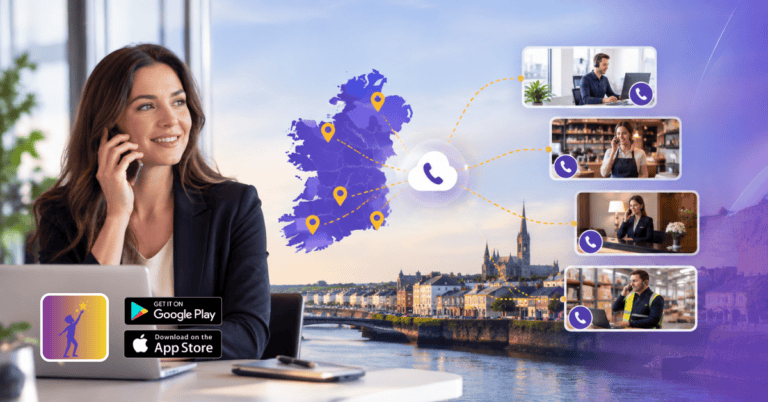
Dromlik provides local Irish numbers across every major region:
| Code | Area |
|---|---|
| 01 | Dublin & Greater Dublin Area |
| 021 | Cork City & surrounding areas |
| 041 | Drogheda, Dundalk, East Meath & Louth |
| 042 | Dundalk & North Louth |
| 043 | Longford & North Midlands |
| 051 | Waterford City & Southeast |
| 053 | Wexford & Southeast coast |
| 056 | Kilkenny & South East inland |
| 057 | Portlaoise, Tullamore & Midlands |
| 059 | Carlow & Southeast inland |
| 061 | Limerick City & Mid-West |
| 066 | Tralee & Kerry |
| 074 | Donegal & Northwest |
| 090 | Athlone & Midlands |
| 091 | Galway City & West of Ireland |
Numbers are available from €5/month per number. If you have an existing Irish number, porting is free and takes 5–10 business days with no gap in service.
GDPR and EU Data Hosting
Your call recordings, contact data, and usage logs need to be stored within the EU. Ask any provider explicitly where their data centres are located. “We’re compliant with GDPR” is not the same as “your data is hosted in the EU.” Dromlik’s infrastructure is hosted within Ireland and the EU — call recordings and contact data don’t leave EU jurisdiction.
Local Support
If your phone system goes down during business hours, you need to reach someone quickly. Check whether support is available during Irish business hours and whether there’s a local point of contact. An international helpdesk with a 24-hour ticket response window is not sufficient for a business-critical system.
No Long-Term Lock-In
The Irish SMB market has been burned by 3–5 year contracts on legacy phone systems that became obsolete halfway through. Insist on monthly or annual rolling terms. Any provider that won’t offer this is a red flag.
Built Around How Different Irish Businesses Actually Work
The right features depend heavily on your sector. A few examples:
Construction and Trades — Ireland’s construction sector is experiencing sustained growth across Dublin, Cork, Limerick, and Galway, and site teams spend most of their time away from a fixed location. What matters most: a business number that works through a mobile app, hunt groups that ring multiple team members at once, and an AI receptionist for when no one’s available. See phone systems for construction and trades.
Restaurants and Hospitality — peak call volumes hit exactly when staff are least available to answer, and a missed reservation call during a Friday dinner service is direct, calculable revenue loss. See how Dromlik works for restaurants.
Financial and Professional Services — firms operating under Central Bank of Ireland oversight need robust call recording with accessible storage, clear data residency, and audit-ready logs.
Recruitment — agencies handle high call volumes from both candidates and clients, often needing different routing depending on caller type. Skills-based routing, CRM call logging, and WhatsApp messaging for candidates are the headline requirements. See the recruitment page.
Real Estate — agents are frequently away from the office and need to be reachable professionally without giving out a personal mobile. See the real estate page.
Features Worth Prioritising
Not every feature matters equally. Here’s how to think about what your business actually needs.
Must-haves for most businesses:
- Call routing and IVR — direct callers to the right person or department automatically
- Voicemail to email — missed calls shouldn’t require logging into a separate system to retrieve messages
- Mobile and desktop apps — your team needs to take business calls on their phones without giving out personal numbers
- Call recording — useful for training, compliance, and resolving disputes
- Hunt groups — ring multiple team members simultaneously or in sequence so fewer calls go unanswered
Worth having if you have a customer-facing team:
- Call queues — manage high inbound volume without losing callers
- Supervisor panel — real-time view of who’s on a call, who’s available, queue length
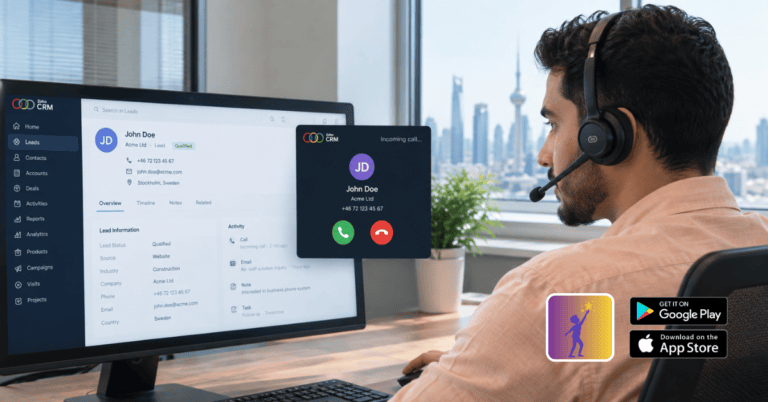
- CRM integration — automatic call logging to HubSpot, Salesforce, Zoho, or Zendesk saves hours per week and gives your team context before they pick up
- Call analytics and reporting — volume by hour, missed call rates, average handling time
Worth considering if you’re growing fast:
- Omnichannel inbox — manage calls, SMS, WhatsApp, and chat in one place rather than juggling separate tools
- AI call transcription — automatic summaries of every call so nothing gets missed
- AI Receptionist — answers calls 24/7 when your team can’t, captures caller details, and routes or responds intelligently
The AI Receptionist: No Longer a Gimmick
Two years ago, AI call handling was a novelty. Today it’s a practical tool for Irish SMBs that can’t afford to miss calls but don’t have the headcount for a full reception function.
An AI receptionist answers every inbound call, handles common queries, takes messages, and can route urgent calls to a real person. It works around the clock — so calls that come in at 7pm or on a Saturday get a professional response rather than ringing out.
It’s particularly useful for trades and construction businesses where team members are on-site, restaurants fielding reservation calls during service, professional services firms that receive enquiries outside business hours, and any business running on a lean team without a dedicated receptionist.
The AI receptionist doesn’t replace your team — it makes sure no enquiry is ignored before your team can get to it.
What Does a Business Phone System Cost in Ireland?
Pricing varies depending on features and the number of users. Here’s a realistic picture using Dromlik’s plans as a benchmark:
| Plan | Monthly Price | What’s Included |
|---|---|---|
| Nucleus | €12/user/month | Calls, routing, IVR, voicemail, call recording, mobile/desktop app, Teams integration |
| Orbit | €22/user/month | Everything in Nucleus plus omnichannel (SMS, WhatsApp, chat, FB), CRM integrations, call centre queues, AI transcription |
| AI Receptionist | +€100/month | 24/7 AI call answering, 200 minutes included, add-on to either plan |
Annual billing reduces costs by around 20%. Local Irish numbers are €5/month, with free porting on all plans.
For a 10-person business on Nucleus, that’s €120/month. Add the AI Receptionist and you’re at €220/month for a system that handles calls around the clock. For most businesses, that pays for itself by recovering a handful of enquiries that would otherwise have gone unanswered.
See the full pricing breakdown at dromlik.ie/pricing.
Questions to Ask Any Provider Before Signing Up
Use these to cut through the sales pitch:
- Can you supply Irish local numbers, and is porting my existing number free?
- Where is my data hosted — specifically, is it within the EU?
- What are your contract terms — monthly, annual, or longer?
- What does support look like? What are your response time commitments?
- Can I trial the system before committing?
- What happens to my number if I leave?
- Are there setup fees or hidden costs beyond the per-user price?
A provider that struggles to answer any of these clearly is one to be cautious about.
How to Switch Without Disruption
Switching phone systems sounds daunting, particularly if you’ve had the same number for years. In practice, it’s straightforward when managed properly.
Number porting in Ireland typically takes 5–10 business days. During that period your existing number continues to work — there’s no gap in service. See how the migration process works at Dromlik.
The Bottom Line
The right phone system for your Irish business depends on your size, how your team works, and how much of your revenue comes through inbound calls. For most SMBs, a cloud PBX with a solid mobile app, Irish number support, and basic call routing will cover the essentials. As you grow, omnichannel and AI features become increasingly worthwhile.
The most important thing is to trial before you commit, confirm that Irish numbers and EU data hosting are included, and make sure there’s a real human on the other end of support when you need them.
See Dromlik in action
Dromlik offers a free trial with no setup fees and free number porting. Book a demo or call us on 01 686 6414.