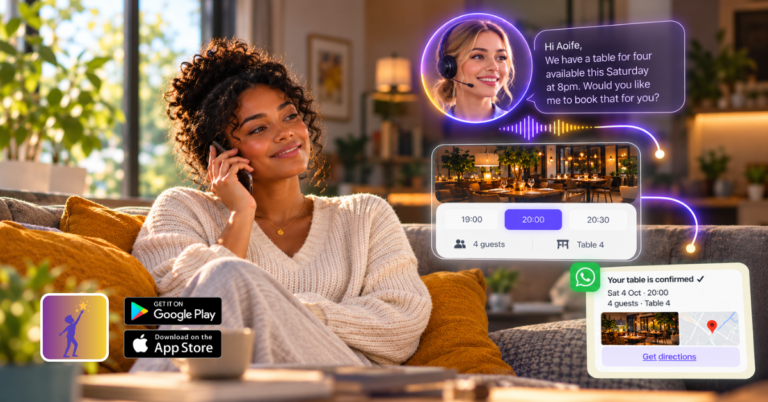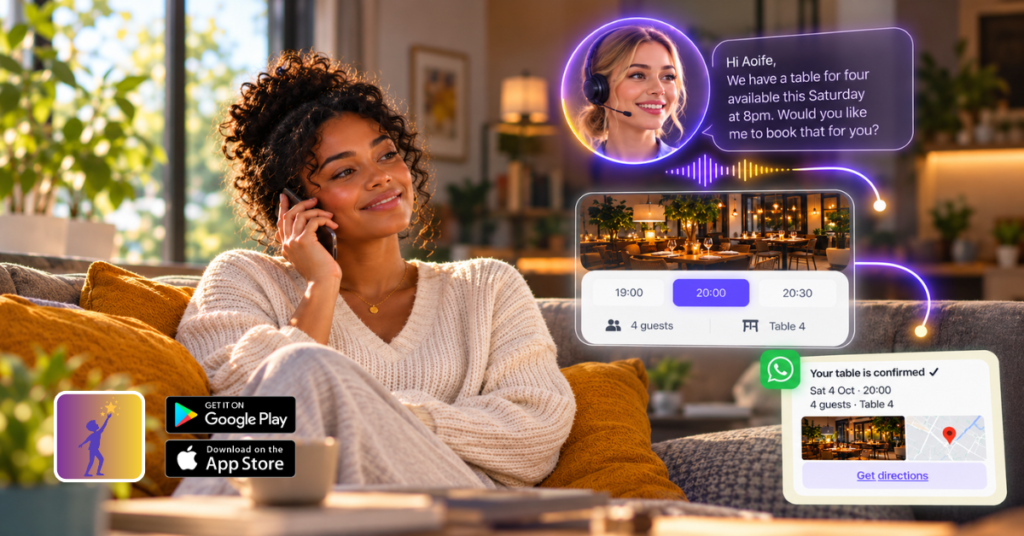
Quick summary: Dromlik Tables is a cloud reservation and front-of-house platform built for independent Irish restaurants and hospitality groups — covering reservations, table assignment, kitchen pacing, waitlists, guest profiles, and a public booking page. It connects natively to Dromlik’s AI receptionist, Niamh, through a built-in MCP connector, so phone bookings are handled automatically with the same availability logic, the same table assignment engine, and the same WhatsApp confirmation as an online booking. No per-cover fees. No POS hardware. No diner accounts. Just fast, clean front-of-house management.
What Dromlik Tables Is
Dromlik Tables is a standalone reservation and front-of-house management platform — separate from the Dromlik phone system, though tightly integrated with it. Irish restaurants use it to manage everything that happens before and during service: taking bookings, assigning tables, managing the kitchen’s covers-per-hour, tracking walk-in waitlists, and building guest profiles that make regulars feel known.
It’s built for independent restaurants and hospitality groups that want professional reservation management without the commission model of platforms like OpenTable or the POS complexity of enterprise hospitality software.
Staff access the platform at tables.dromlik.com. Guests book through a clean public booking page. Niamh — Dromlik’s AI receptionist — takes phone bookings through a native MCP connector that reads the same live availability and writes to the same system as every other channel.
The Problem With How Most Irish Restaurants Manage Reservations
Independent Irish restaurants typically manage reservations in one of three ways, each with significant limitations:
A paper book or a shared notes app. No availability visibility, no guest history, no confirmation messages, and a complete inability to scale. One booking taken by two different people means a double-booking on Saturday night.
A third-party platform like OpenTable or TheFork. These platforms bring bookings — but at a cost. Per-cover fees accumulate quickly, and the restaurant is effectively renting access to its own dining room through someone else’s platform. Guest data belongs to the platform, not the restaurant.
A basic online form or email booking. No real-time availability, no automatic table assignment, no confirmations, and significant manual work for the team to manage incoming requests.
None of these work well for a restaurant that wants to own its guest relationships, manage its floor intelligently, and give phone callers the same experience as online bookers.
Dromlik Tables doesn’t charge per booking or per cover. Irish restaurants keep the margin that third-party booking platforms take — while owning their guest data and guest relationships directly.
What Dromlik Tables Does
Reservations and Guest Management
Bookings come in from three channels: staff entry (at the tables.dromlik.com dashboard), the public booking page, or a phone call handled by Niamh through the MCP connector. All three channels use the same availability logic, the same table assignment engine, and the same pacing rules — so a booking is a booking regardless of how it arrived.
Each reservation moves through a clear status flow: pending → confirmed → seated → completed, with no-show and cancelled as exit states. Staff mark arrivals and no-shows with a single tap. If a no-show walks in late, one tap undoes it and restores the booking.
The reservations view separates upcoming and past shifts, with instant guest search across both.
Guest CRM — Built Automatically
Guest profiles build from bookings without diners ever creating an account. A guest books by phone — Niamh takes the booking — and their profile is created or updated automatically. Book online, same profile. The matching logic uses normalised phone number and email, so the same guest booking by phone and online lands on one profile rather than creating duplicates.
Each profile shows:
- Total visits, cancellations, and no-shows
- Average party size
- Dietary requirements and preference notes
- Full booking history
For Irish restaurants building long-term relationships with regulars — the table they prefer, the allergy they mentioned six months ago, how often they actually show up — this is the guest intelligence that makes service feel personal rather than transactional.
Table Assignment Engine
Tables are assigned automatically by an engine that applies the same logic across every channel — so there’s no inconsistency between how staff assign tables and how the system handles an online booking.
The assignment logic:
Best fit — the smallest table that fits the party wins. A table for two gets a 2-top, not a 4-top that could have taken a larger party later.
Seating preferences — window seats, outdoor tables, wheelchair-accessible positions, or a specific section are honoured when available.
Automatic moves — if no free table fits a new booking, the engine checks whether an existing booking can move to another table that still meets its requirements, and moves it to make room. Seated guests are never moved.
Table locks — staff can lock a booking to a specific table so the engine never reassigns it.
Combinations — managers define which tables can be joined (Table 1 + Table 2 = 6 seats, for example). The engine uses combinations automatically for large parties when no single table fits.
Kitchen and Seating Pacing
Pacing rules prevent the kitchen and floor from being overwhelmed at peak times — a common problem for Irish restaurants that take a full Saturday of bookings and then find service collapsing under the volume.
Managers set:
- Pacing interval — 15, 30, or 60 minutes
- Covers per interval — maximum covers starting in each window
- Simultaneous cap — maximum bookings overlapping at any one moment
These limits apply to every channel — staff entry, the booking page, and Niamh on the phone. A booking that would exceed the pacing cap is rejected automatically unless a manager authorises an override. No more accidentally over-promising the kitchen.
Waitlist — Walk-ins and Future Dates
The waitlist has two separate flows for two different situations:
Door queue — for walk-ins during service. Staff add the party, log the quoted wait time, and the live timer tracks elapsed time. When a table becomes available, the party is notified. One tap marks them seated.
Advance requests — for guests wanting a fully booked date. Staff log the requested date, preferred time, and party size. When a cancellation creates space, staff mark the request as booked and contact the guest directly.
Public Booking Page
Each restaurant gets a public booking page at:
tables.dromlik.com/book?tenant={restaurant-slug}
Guests pick a date, party size, and time. Available slots are calculated in real time using the same opening hours, assignment engine, and pacing rules as every other channel. Guests only see times that are actually available — no false availability, no manual management of what shows online.
The page requires no guest login, no app download, and no Dromlik account.
WhatsApp Confirmations
Every booking — whether taken by staff, booked online, or handled by Niamh on a call — triggers an automatic WhatsApp confirmation to the guest. This requires WhatsApp to be set up on the restaurant’s Dromlik phone system.
For Irish restaurants dealing with no-shows — a Saturday night no-show represents a table that could have been turned — WhatsApp reminders sent before the booking date reduce non-attendance without any additional effort from the team.
The MCP Connector: Phone Bookings That Work Like Online Bookings
The MCP connector is what makes Dromlik Tables genuinely different from a standalone reservation system. Every restaurant gets its own private MCP server that Niamh — Dromlik’s AI receptionist — connects to during a phone call.
When a caller rings to make a reservation, Niamh:
- Looks up the caller by phone number — if they’re an existing guest, she greets them by name and has access to their notes and active bookings
- Checks live availability against current bookings, opening hours, and pacing rules
- Creates the reservation and assigns a table using the same engine as every other channel
- If the requested time is fully booked or would exceed pacing, she offers the next available slot or adds the caller to the waitlist
- Sends the guest a WhatsApp confirmation immediately after the call
From the restaurant’s perspective, a phone booking handled by Niamh is indistinguishable from an online booking — it appears in the dashboard with the same information, the same table assignment, and the same confirmation sent. No manual entry, no risk of double-booking, no missed reservations during service.
A booking from the public page, a booking entered by staff, and a booking taken by Niamh on the phone all go through the same availability check, the same table assignment engine, and the same pacing rules. There’s no separate phone booking process that creates inconsistencies.
Multi-Location Hospitality Groups
For Irish hospitality groups operating multiple restaurants, Dromlik Tables supports separate workspaces per location — each with its own data, its own tables, its own pacing rules, and its own MCP connector for Niamh. A manager with access to multiple locations switches between them from a single login without signing in again.
Each location’s data is fully isolated from every other restaurant on the platform.
How It Fits With the Dromlik Phone System
Dromlik Tables is a standalone product — Irish restaurants can use it independently of the Dromlik phone system. But the two are designed to work together:
- Niamh handles phone bookings through the MCP connector, with the same real-time availability as the online booking page
- WhatsApp confirmations are sent through the restaurant’s Dromlik phone system
- The phone system’s AI receptionist routes non-booking calls — allergen queries, directions, opening hours — using the restaurant information configured in Tables
For Irish restaurants that want to solve both their reservation management and their phone handling in one place, the combined setup means no call goes unanswered and no booking falls through.
Getting Started
Dromlik Tables is set up by the Dromlik team — new restaurants are onboarded directly. Contact the Dromlik team to get started, and see the full technical documentation for detail on the MCP connector and configuration options.
Manage your restaurant's reservations with Dromlik Tables
Talk to the Dromlik team about setting up Tables for your restaurant — with or without the AI receptionist integration.