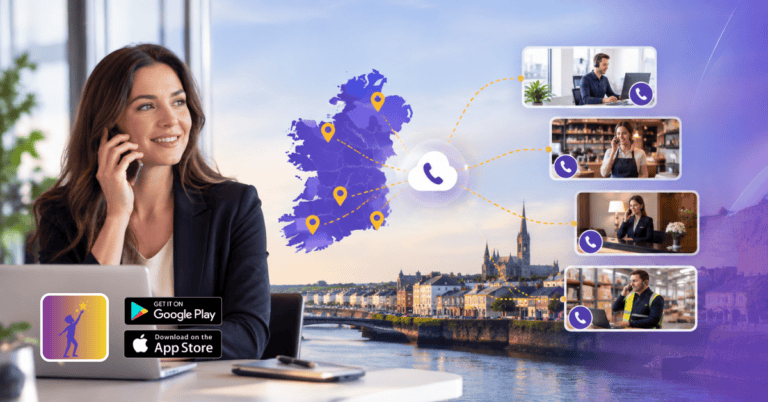
Cloud PBX has become the default business phone system for Irish SMEs over the last five years. If you’re evaluating one for the first time, or reconsidering a system you’ve had for a while, there’s a lot of information out there — much of it written for large enterprises or the US market.
This guide covers the seven things that actually matter for Irish SMEs specifically.
1. A Cloud PBX Is Just a Business Phone System That Lives Online
PBX stands for Private Branch Exchange — it’s the technology that manages how calls are routed within a business. Traditionally this was a physical box of hardware installed on your premises. A cloud PBX does the same thing, but the infrastructure lives on remote servers managed by your provider rather than in your office.
What this means in practice: there’s no hardware to buy or maintain, no engineer visits to change a routing rule, and your team can make and receive business calls from any device — mobile, laptop, or desk phone — from any location.
For Irish SMEs without a dedicated IT function, this is the most important distinction. A cloud PBX is managed by your provider, not by you.
A traditional PBX is a box in your office that you maintain. A cloud PBX is a system your provider maintains — you just use it.
2. Your Existing Irish Numbers Come With You
The most common concern when switching to a cloud PBX: “We’ve had our 01 number for 10 years — can we keep it?”
Yes. Number porting transfers your existing Irish numbers to your new system. The number stays exactly the same — customers dial the same number, it just rings through a different system. In Ireland, porting typically takes 5–10 business days, and your existing number keeps working throughout — there’s no gap in service.
A reputable provider handles the porting process for you and charges nothing for it. If a provider charges for porting, or makes you manage the process yourself, that’s a red flag.
Dromlik ports Irish numbers across all area codes — 01, 021, 061, 091, and more — free of charge, managed end-to-end by our team.
3. You Don’t Need New Hardware
One of the most persistent myths about switching phone systems: that it requires buying new equipment. For most Irish SMEs, it doesn’t.
A cloud PBX works through softphone apps — software on your team’s existing mobiles and laptops that handles calls just like a desk phone would. Your team downloads the app, logs in, and starts taking calls. No new hardware, no desk phones, no installation.
If your team prefers physical desk phones — for a reception desk, a call centre function, or personal preference — modern IP phones like the Yealink T7 and T8 series work with any cloud PBX and connect over your existing broadband. But they’re optional, not required.
The majority of Dromlik customers use the mobile and desktop apps exclusively — no desk phones, no new equipment, no upfront hardware cost.
4. Call Routing Is Where Most Businesses See the Biggest Improvement
The feature that makes the most immediate difference for Irish SMEs isn’t video calling or omnichannel messaging — it’s call routing.
With a basic phone system, calls ring one number until someone picks up or it times out. With a cloud PBX, you define exactly what happens:
- During business hours, calls ring all available team members simultaneously — whoever’s free picks up
- If nobody answers within 20 seconds, it rolls to voicemail which is emailed to the relevant person
- Outside business hours, callers hear a professional after-hours message and can leave a voicemail or be directed to your AI receptionist
- On Irish bank holidays, a specific holiday message plays automatically
- Different departments have different routing rules — sales calls go to sales, support calls go to support
All of this is set up once and runs automatically. For Irish SMEs where calls are a primary source of new business, getting routing right is the single highest-impact change you can make to your phone setup.
5. Integration With Your CRM Changes How Your Team Works
If your business uses a CRM — HubSpot, Salesforce, Zoho, Zendesk — connecting it to your cloud PBX changes the daily experience of every person on your team who handles calls.
Before integration: A call comes in, the agent doesn’t know who it is until they introduce themselves. The call ends, the agent manually creates a note, updates the contact record, and tries to remember the details accurately.
After integration: A call comes in, the caller’s full record opens automatically on screen before the agent says hello. The call ends, it logs automatically — duration, recording, notes — to the right contact in the CRM. No manual entry, no missed follow-ups, no inaccurate records.
For a 10-person team handling 30 calls a day, this saves 20–30 minutes per person per day. At scale, it’s one of the highest-ROI features in the system.
Dromlik integrates natively with HubSpot, Salesforce, Zoho, and Zendesk on the Orbit plan.
6. AI Call Handling Is Now Practical for SMEs — Not Just for Enterprise
Two years ago, AI call answering was a feature discussed in enterprise contexts. Today it’s accessible, affordable, and genuinely useful for Irish SMEs of almost any size.
An AI receptionist answers calls when your team can’t — during busy periods, outside business hours, or when everyone is already on a call. It holds a real conversation, handles common queries, takes bookings, captures detailed messages, and routes urgent calls to a human with full context.
For Irish businesses where missed calls mean missed revenue — trades companies, restaurants, recruitment agencies, professional services firms, estate agents — AI call handling closes the gap without adding headcount.
Dromlik’s AI receptionist — Niamh — is available as a system-wide add-on at €100/month (restaurant plans from €125/month), supports over 20 languages, and integrates directly with booking systems like OpenTable and TheFork. A call answered by Niamh costs a fraction of a missed lead.
Niamh is available from €100/month system-wide — not per user. For a 10-person team, that’s €10 per person per month for 24/7 call coverage. Call the demo line on +353 1 263 4204 to hear it in action.
7. Switching Is Faster and Less Disruptive Than Most Businesses Expect
The most common reason Irish SMEs stay on an outdated phone system longer than they should: the assumption that switching will be complicated, disruptive, and expensive.
In practice, with the right provider:
- Your numbers port across in 5–10 business days with no service gap
- Your team is live on the new system within minutes of go-live — download the app, log in, start taking calls
- No hardware is required for a standard setup
- Configuration is handled for you — routing rules, IVR, greetings, CRM integration — by the provider’s team, not by you or an IT partner
- A free trial lets you test the system properly before committing to anything
For most Irish SMEs in the 5–50 person range, the switch from an existing system to Dromlik takes less than two weeks from first conversation to go-live, including number porting.
Quick Reference: Cloud PBX for Irish SMEs
| Question | Answer |
|---|---|
| Do I need new hardware? | No — mobile and desktop apps work on existing devices |
| Can I keep my Irish number? | Yes — porting is free and managed by Dromlik |
| Where is my data hosted? | Within the EU as standard |
| How long does switching take? | Typically under 2 weeks including number porting |
| What does it cost? | From €15/user/month (monthly) or €12/user/month (annual) |
| Is there a free trial? | Yes — 7 days, no setup fees |
| Do I need IT support? | No — Dromlik configures everything for you |
See the full pricing breakdown at dromlik.ie/pricing.
Ready to move your business to a cloud PBX?
The Dromlik team will walk you through your specific setup, port your existing numbers, and have you live in under two weeks. Free 7-day trial, no setup fees.