AI phone answering has moved quickly from novelty to practical tool. If you’ve been reading about it and wondering what actually happens on a call — how the AI handles different types of callers, what it can and can’t do, and how it fits into a real business — this guide walks through it in concrete terms.
What Happens on an AI-Answered Call
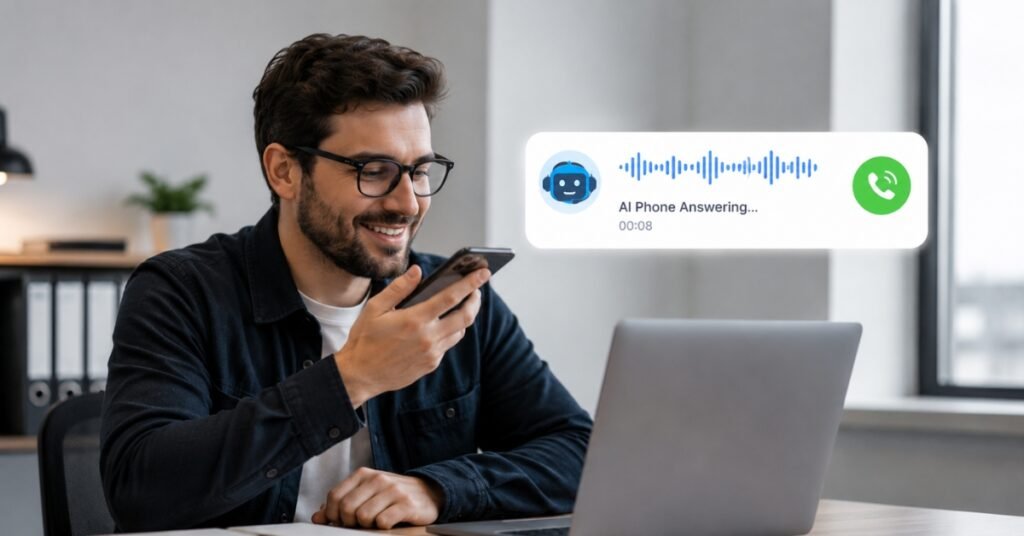
When a caller dials your number and the AI picks up, the experience depends entirely on how well the system has been set up. A well-configured AI phone answering system works like this:
The greeting. The AI answers within a couple of seconds with a natural, professional greeting in your business’s name. Not “your call is important to us” hold music — an actual live answer, like a person picked up.
Understanding the caller. The caller says why they’re calling in natural language — “I’d like to make a booking for Saturday evening,” or “I’m calling about the quote you sent over” — and the AI understands the intent. No keypad menus, no “please state your query in one word.”
Handling the request. Depending on what the caller needs, the AI either resolves it directly (takes a booking, answers a question, captures their details) or routes the call to the right person with context already attached.
Following up. After the call, the caller can receive a confirmation or summary via WhatsApp or SMS, and a call summary is sent to your team so nothing gets missed.
This is the full loop. Most callers, handled without anyone on your team needing to pick up.
What the AI Can Handle Directly
The strength of AI phone answering is in volume and consistency — handling the same types of calls reliably, around the clock, without variation in quality.
Bookings and reservations. The AI can take a booking, check availability, and confirm it — writing directly into reservation systems like OpenTable, TheFork, or ZenChef for restaurants, or syncing with calendar and scheduling tools for other businesses.
Common questions. Opening hours, location, parking, pricing, services offered, what to bring to an appointment — anything that your team answers the same way every time. The AI handles these without escalating.
Message taking. When a caller’s request is more complex or specific, the AI captures their name, number, and reason for calling in detail and sends it to the relevant person — far more useful than a voicemail that may go unchecked.
After-hours calls. The AI doesn’t know the difference between 9am and 11pm. Calls that come in outside business hours get the same quality of response as calls during the day, with appropriate handling (taking a message, confirming when the business reopens, or booking an appointment for the next available slot).
Multilingual calls. Dromlik’s AI receptionist Niamh supports over 20 languages, detecting the caller’s language automatically. For businesses in tourist-heavy areas or with international customers, this covers interactions that a human receptionist might struggle with.
What Gets Routed to a Human
AI phone answering works best when it’s clear about its limits. The scenarios that should always go to a person:
- Complaints or disputes. A caller who is upset needs a human response. The AI should recognise the tone and escalate immediately rather than attempting to resolve it.
- Complex or nuanced requests. Large group bookings, bespoke quotes, sensitive queries, or anything that requires judgment and context beyond a FAQ.
- Urgent matters. The AI can be configured to recognise urgency signals and route those calls straight to a designated contact, even outside business hours.
- Anything the caller explicitly asks to escalate. If a caller says “can I speak to someone,” the AI routes them — it doesn’t persist.
The goal isn’t to handle every call with AI. It’s to handle the right calls with AI so your team’s time goes toward the ones that actually need them.
How It Compares to the Alternatives
vs. Voicemail
Voicemail has a fundamental problem: most callers don’t leave one. When they do, the message is often incomplete, and there’s no confirmation that anyone received it. AI phone answering replaces this with a live interaction — the caller gets something useful, and your team gets a structured summary rather than a rambling voice note.
vs. A Human Receptionist
A human receptionist is better for complex, sensitive, or relationship-driven interactions — and for the face-to-face component that AI simply can’t replace. But a human receptionist works set hours, costs significantly more than €100/month, and can only handle one call at a time. AI phone answering covers the volume, the after-hours gap, and the high-frequency routine calls — complementing a human rather than replacing them in full.
vs. A Call Answering Service
Third-party call answering services use human agents who work from a script on behalf of multiple clients. Quality varies, agents don’t know your business deeply, and there’s typically a per-call or per-minute cost that scales with volume. AI phone answering is a fixed monthly cost, has consistent quality, and can be customised to your specific business in detail.
Setting It Up Well
The quality of AI phone answering is directly tied to how well it’s configured. The things that matter most:
A thorough knowledge base. The AI answers questions based on what it’s been told about your business. Vague or incomplete setup means vague or incomplete answers. Dromlik’s onboarding process works through your FAQs, services, hours, pricing, and how you want different types of calls handled — this is done with you, not left for you to figure out.
Clear routing rules. The AI needs to know what to do in each scenario: who gets urgent calls, what happens after hours, which department different enquiries go to. Set these up precisely and they run automatically.
Regular review. Caller questions evolve. A new service, a change in hours, a frequently asked question you hadn’t anticipated — the knowledge base should be updated periodically so the AI keeps up.
What It Costs
Niamh, Dromlik’s AI receptionist, is available as an add-on to any Dromlik plan at €100/month, which includes 200 minutes of AI call handling. Additional minutes are available in 200-minute blocks at €75.
A 7-day free trial is available with no setup fees. See the full pricing breakdown at dromlik.ie/pricing.
Trying It
The most useful thing you can do before deciding is call the Dromlik demo line: +353 1 263 4204. It’s connected to a live demo setup — a restaurant scenario — so you experience exactly what your callers would experience, rather than reading a description of it.
Or book a demo with the team to walk through how it would work for your specific business and call types.