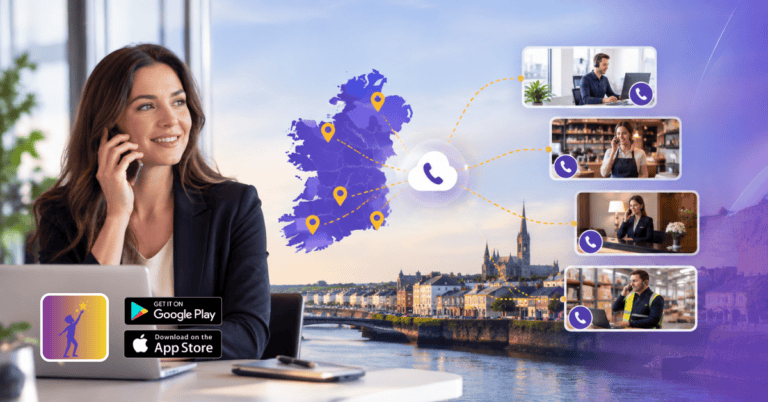
When a business grows past 30 or 40 people, the phone system that worked at 10 starts showing its limits. A single hunt group that rings everyone made sense when the team was small. It doesn’t work when you have a sales team, a support team, an accounts function, and a management layer that all need to handle calls differently.
This guide covers what enterprise calling software actually needs to do for Irish businesses at this scale, what to look for when evaluating options, and how Dromlik’s platform supports teams from 40 to several hundred seats.
What Changes at Enterprise Scale
Smaller businesses need a phone system that’s simple, affordable, and works on mobile. That’s still true at 40+ seats — but additional requirements emerge:
Departmental routing becomes critical. At 10 people, everyone can answer most calls. At 50, you need sales calls to reach sales, support calls to reach support, and finance calls to reach finance — automatically, without relying on someone manually transferring.
Supervisor visibility matters. Team leaders need to see what’s happening across their team in real time: who’s on a call, how long the queue is, how many calls have been missed today. Without this, managing a call-handling team is guesswork.
Call recording becomes non-negotiable. At enterprise scale, call recording is no longer just useful — it’s often required. Financial services firms under Central Bank of Ireland oversight, legal practices, and any business handling sensitive customer data needs robust, accessible recording with clear retention policies.
CRM integration needs to be deep, not superficial. A click-to-call button isn’t enough. Enterprise teams need automatic call logging, screen pops that surface the right record before the call is answered, and bidirectional sync so the CRM stays accurate without manual input.
The system needs to scale without friction. Adding 10 users, spinning up a new department number, or opening a new location should take minutes — not require an engineer visit or a call to a support team.
Below this threshold, a phone system just needs to work. Above it, it needs to actively support how different teams operate — with routing logic, supervisor tools, and integrations that reflect your org structure.
Core Features for Enterprise Calling in Ireland
ACD and Call Queues
Automatic Call Distribution (ACD) routes inbound calls to the right agent or team based on rules you define — availability, skill, department, or caller history. Combined with call queues that hold callers with position announcements and estimated wait times, this is the foundation of any enterprise calling setup.
Skills-Based Routing
Different calls need different people. A support escalation needs a senior agent. A query in French needs a French speaker. Skills-based routing matches the call to the right person automatically, reducing transfers and improving first-call resolution.
Real-Time Supervisor Tools
A live wallboard showing queue depth, agent availability, active calls, and SLA status gives team leaders the visibility to manage effectively. Dromlik’s Orbit plan includes supervisor panels and real-time wallboards as standard — not as a paid add-on.
Call Recording and Transcription
Every call recorded, stored accessibly, and searchable. AI transcription on top of recording means you don’t need to listen back to a 20-minute call to find one detail — the transcript and summary are there immediately. Useful for training, compliance, and quality assurance.
Visual Call Flow Designer
At enterprise scale, call routing logic gets complex. A drag-and-drop visual call flow designer means routing rules can be built, adjusted, and tested without writing configuration files or calling a support team. Changes take effect immediately.
Omnichannel Inbox
Enterprise customers don’t communicate by phone alone. SMS, WhatsApp, web chat, and Facebook messages all need to be manageable from the same interface as calls — with full conversation history, so an agent handling a WhatsApp message from a customer can see their last three phone calls in the same view.
CRM and Helpdesk Integration
Native integration with Salesforce, HubSpot, Zoho, and Zendesk — not just click-to-call, but automatic call logging, screen pops on inbound calls, contact sync, and workflow triggers. For a 50-person team, eliminating manual call logging alone saves meaningful hours per week per person.
Microsoft Teams Integration
Many Irish businesses at this scale already use Teams for internal communication. Dromlik’s Teams integration adds business calling directly into Teams — without requiring Microsoft’s own Calling Plans, which are expensive and limited by comparison.
Irish-Specific Considerations at Enterprise Scale
Compliance and data residency. Irish financial services firms operate under Central Bank of Ireland oversight. Legal practices have professional conduct obligations. Healthcare businesses handle data under strict GDPR frameworks. All of these require call recording with defined retention periods and EU-hosted data storage. Dromlik’s infrastructure is EU-hosted as standard.
Multiple locations and numbers. A business with offices in Dublin, Cork, and Limerick needs numbers in each area code, routing that reflects local team structure, and centralised management from one dashboard. Dromlik provides local Irish numbers across 15 area codes from €5/month per number, all managed from a single account.
Number porting at scale. Migrating a large estate of numbers is more complex than a small business port. Dromlik’s team manages this process end-to-end — porting in batches if needed, with no gap in service throughout.
Irish bank holiday routing. Time-based routing needs to account for Irish public holidays, which don’t align with UK or international calendars. This should be configurable natively, not require a manual workaround every time a bank holiday approaches.
For Irish businesses handling customer data at enterprise scale, call recordings and contact data must be stored within the EU. Always confirm this explicitly with any provider — “GDPR compliant” is not the same as “EU-hosted.”
The AI Layer at Enterprise Scale
AI isn’t just a feature for small businesses without a receptionist. At enterprise scale, it serves different functions:
Overflow handling. During peak periods, even a large team can be overwhelmed. An AI receptionist handles overflow calls that would otherwise queue, taking messages or handling routine queries while the team manages the volume spike.
After-hours coverage. A 50-person business still has a gap between 6pm and 9am. Dromlik’s AI receptionist — Niamh — covers this gap, answering calls, taking messages, and sending WhatsApp follow-ups, without requiring an on-call rota.
Call transcription and analytics. At scale, no manager can listen to a meaningful sample of calls. AI transcription and call summaries make quality review scalable — flag calls by keyword, review summaries rather than recordings, identify training needs from patterns across hundreds of calls rather than a handful.
What It Costs
Dromlik’s enterprise-capable plan is Orbit:
| Orbit | €22/user/month |
| AI Receptionist (Niamh) | +€100/month |
| Extra AI minutes | €75 per 200-minute block |
| Call recording upgrade | +€40/month (500 → 10,000 mins) |
| AI transcription upgrade | +€20/month |
| Local Irish numbers | €5/month per number |
A 50-person team on Orbit with AI receptionist, call recording upgrade, and AI transcription comes to approximately €1,260/month — including omnichannel messaging, CRM integration, supervisor tools, and real-time wallboards. Annual billing reduces this by around 20%.
Annual billing saves around 20%. See the full pricing breakdown.
Migrating From a Legacy System
The most common scenario at enterprise scale is replacing an on-premise PBX or an incumbent hosted provider that’s become too expensive, too rigid, or no longer fit for a hybrid working environment.
Key considerations for migration at this scale:
- Number porting — Dromlik manages the porting process in batches, with no gap in service. Irish numbers typically port in 5–10 business days.
- Hardware — Dromlik works with existing SIP-compatible desk phones if your team prefers physical handsets. See the SIP phones page for compatible hardware.
- Parallel running — for larger migrations, old and new systems can run in parallel during transition to eliminate risk
- Training — the Dromlik team handles onboarding and configuration; team training on the app takes under an hour for most users
For more detail on the migration process, see Migrate to Dromlik.
Ready to see it in action?
For businesses at 40+ seats, we recommend starting with a demo to walk through your department structure, routing logic, CRM integration, and compliance requirements before configuring the trial environment.