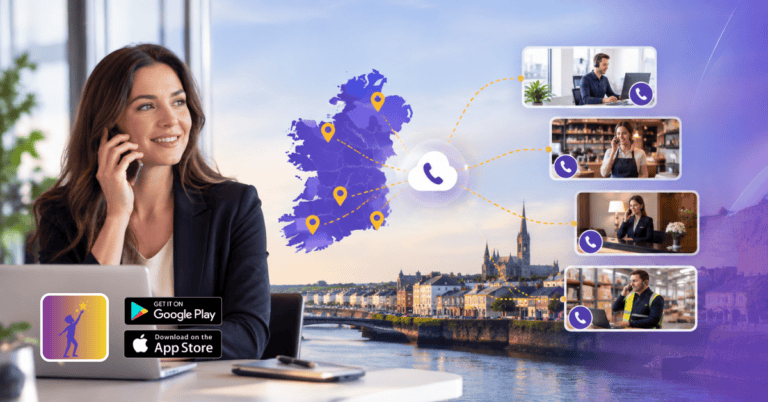
Your office phone number is often a customer’s first point of contact with your business. Whether you’re setting one up for the first time or rethinking your current setup, this guide covers the practical decisions Irish SMBs actually need to make — what types of numbers are available, how to choose one, and how to manage multiple numbers as you grow.
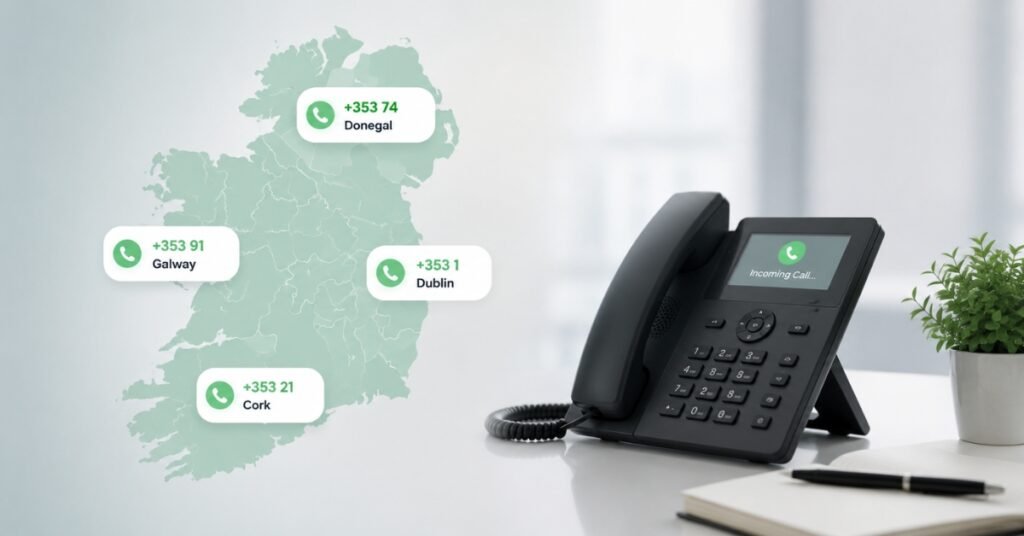
Local Numbers Available Through Dromlik
We sell Irish local numbers across the country at €5/month per number, covering:
| Code | Area |
|---|---|
| 01 | Dublin & Greater Dublin Area |
| 021 | Cork City & surrounding areas |
| 041 | Drogheda, Dundalk, East Meath & Louth region |
| 042 | Dundalk & North Louth |
| 043 | Longford & North Midlands |
| 051 | Waterford City & Southeast region |
| 053 | Wexford & Southeast coast |
| 056 | Kilkenny & South East inland |
| 057 | Portlaoise, Tullamore & Midlands region |
| 059 | Carlow & Southeast inland |
| 061 | Limerick City & Mid-West region |
| 066 | Tralee & Kerry region |
| 074 | Donegal & Northwest region |
| 090 | Athlone & Midlands region |
| 091 | Galway City & West of Ireland |
A local number signals that your business has a real presence in that area, which builds trust with customers searching for nearby services — particularly important for trades, professional services, and any business competing on local relevance rather than national reach.
If you operate across multiple regions, you can hold numbers in several areas simultaneously — for example, a Dublin and a Cork number both routing into the same team — so customers in each area see a local number, while you manage everything from one platform.
Why a Local Number Beats Using Your Mobile
Plenty of Irish SMBs — especially sole traders and small teams — start out giving customers a personal mobile number simply because it’s what’s available. It works at first, but it creates problems as the business grows:
- It doesn’t scale. A personal mobile is tied to one person. If that person is unavailable, on annual leave, or eventually leaves the business, there’s no way to hand the number over or add a second person to answer it. A local business number isn’t tied to any individual — you can add team members, route calls between them, and keep the number running regardless of who’s answering on any given day.
- It looks more professional. A mobile number on a website, van, or invoice reads as a one-person operation, whether or not that’s the case. A local number signals an established, credible business — which matters when you’re competing for jobs or clients against larger competitors.
- It unlocks a real phone system. A personal mobile can’t do call routing, hunt groups, voicemail-to-email, call recording, or IVR menus — it’s just a phone ringing. A proper local business number is the entry point to all of that: calls can ring multiple people at once, route to the right department, or fall through to an AI receptionist when no one’s free. None of this is possible on a number that’s just forwarding to someone’s pocket.
- It separates work from personal life. Customers calling a business number at 9pm on a Saturday is a normal expectation if that number is your personal mobile. A dedicated local number lets you set proper business hours and after-hours handling, so you’re not on call around the clock by default.
- It protects continuity. If a staff member leaves, a business number stays with the company — no awkward “please don’t call this number anymore” messaging to existing customers, and no risk of a departing employee taking your customer relationships with them.
For most growing Irish SMBs, this is the real argument for getting a proper local number sooner rather than later — not the number itself, but everything it enables once it’s in place.
How to Choose the Right Local Number
A few practical factors matter more than they might seem:
- Match the number to where your customers are. If you serve Dublin, get a 01 number. If you’re expanding into Cork or Galway, a matching local number for that region builds trust faster than a number with no local connection.
- Multiple regions, multiple numbers. If you operate in more than one area, hold a local number for each — all routing into the same team, so customers everywhere see a number that looks local to them.
- Memorability isn’t usually worth chasing. Sequential or repeating-digit numbers can help slightly, but for most SMBs it’s not worth paying a premium for. A standard number with good call handling behind it matters far more than the digits themselves.
- Caller ID accuracy. Make sure your number displays correctly and consistently on customer devices — when a business number shows up as “unknown” or a random string, answer rates drop. This is usually a setup issue, not a number issue, and worth checking with your provider.
Managing Multiple Numbers
Many businesses end up needing more than one number as they grow — a main line, a number for a specific department, or separate lines per location. Here’s how that typically breaks down:
| Number Type | Primary Use | Best For |
|---|---|---|
| Main line | General enquiries | First point of contact for all callers |
| Department line | Specific teams | Sales, support, accounts |
| Direct extension | Individual staff | Client relationship managers, account leads |
| After-hours line | Out-of-office contact | Routing to voicemail or an AI receptionist |
The key is having all of these managed through one platform rather than separate providers and separate bills. A proper business phone system lets you add numbers, set routing rules, and manage everything from a single dashboard — so a call to your Cork number and a call to your Dublin number both land in the same place for your team to handle, with the right context attached.
Routing: What Happens When Someone Calls
The number itself is only half the picture — what happens after someone dials it matters more. Modern systems let you set rules like:
- During business hours, calls ring the right team or department directly
- If no one answers within a set number of rings, the call goes to voicemail, gets forwarded, or is picked up by an AI receptionist
- Outside business hours, callers hear an appropriate after-hours message rather than ringing out
This is set up once and runs automatically, so you’re not relying on someone manually forwarding calls or remembering to switch on an out-of-office message.
Connecting Your Number to the Rest of Your Business
A modern office phone number isn’t just a way to receive calls — connected properly, it becomes part of your broader customer record. When integrated with your CRM or helpdesk, an incoming call can automatically surface the caller’s history, so whoever answers already knows who they’re talking to and why.
Dromlik integrates with:
- Salesforce — automatic call logging and screen pops for sales teams
- HubSpot — call activity synced to contact records
- Zendesk — calls linked to support tickets
- Microsoft Teams — calls and presence unified with your existing workspace
For most SMBs, this is the difference between a phone number that’s just a phone number, and one that actively supports how your team works.
Taking Calls on Mobile Without Losing Your Local Number
Staff increasingly take business calls from mobile devices rather than desk phones. With Dromlik, your local number works through an app on the mobile your team already carries — there’s no separate handset needed, and no need to give out personal mobile numbers.
This matters for two reasons: your customers always see your business’s local number regardless of who answers or where they’re standing, and when someone leaves the company, you can revoke their access instantly without changing the number on a van, website, or printed materials.
Industry Considerations
Different sectors lean on their office phone number setup differently:
- Trades and construction often benefit from a single memorable number routed intelligently to whoever’s available, since staff move between sites
- Professional services firms frequently use department-specific lines to route enquiries to the right expertise immediately
- Restaurants and hospitality prioritise a number that’s easy to find and dial quickly, often paired with AI call handling during peak service hours when staff can’t pick up
- Real estate agencies sometimes assign numbers per agent or per listing for direct accountability
Getting Set Up
Setting up a new office phone number — or porting an existing one — is usually faster than businesses expect. With Dromlik, local Irish numbers are available from €5/month per number across all the regions listed above, or you can port an existing number over with no setup fees. Porting typically takes 5–10 business days, and your existing number keeps working throughout, so there’s no gap in service.
If you’d like to talk through what setup makes sense for your business, get in touch with our team.