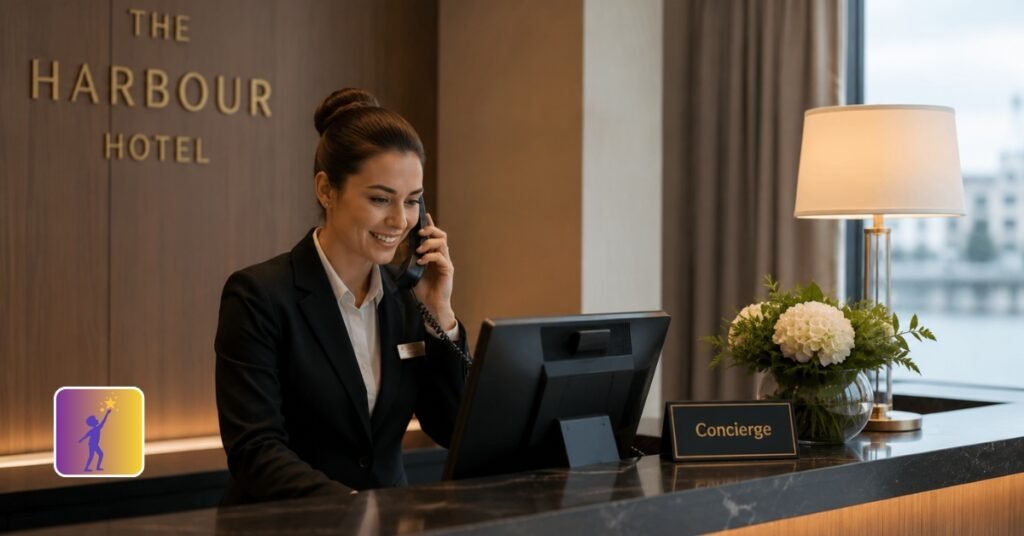
For hotels, the phone never really stops. Check-in queries, reservation calls, requests for local recommendations, questions about availability — they come in during breakfast service, during the evening rush, and at 11pm from a guest who’s just arrived. Most hotel teams can’t consistently cover all of it, and the calls that fall through represent either missed bookings or a guest experience that starts badly.
An AI receptionist for hotels addresses this directly. This guide covers what it actually does in a hotel context, how it fits into a hotel’s existing setup, and what to look for when evaluating one.
What an AI Receptionist Does for a Hotel
An AI receptionist answers inbound calls live — not a voicemail, not a hold queue, but a real conversation. In a hotel context, it handles the types of calls that make up the majority of front desk phone volume:
Reservation enquiries and bookings Checks availability, confirms room types and rates, and takes a booking — syncing directly with your property management or reservation system so the booking appears immediately without manual entry.
Pre-arrival questions Check-in times, parking, directions, accessibility, pet policies, early arrival requests — the AI handles these consistently and accurately based on the information it’s given during setup.
In-stay requests Requests for additional towels, a wake-up call, restaurant recommendations, or local information can be handled or routed to the appropriate department without the front desk needing to pick up.
After-hours calls Calls that come in when reception is closed get a professional, helpful response rather than ringing out. The AI can take a booking, answer a question, or capture a message and route it to the duty manager if urgent.
Multilingual handling Dromlik’s AI receptionist — Niamh — supports over 20 languages, detecting the caller’s language automatically. For Irish hotels with international guests, this covers interactions that a front desk team member may not be able to handle confidently.
The Problem It Actually Solves
Hotel front desk teams are pulled in multiple directions simultaneously — checking guests in, handling walk-ins, managing in-person queries, and fielding calls at the same time. During peak periods, the phone becomes the lowest priority, and calls that go unanswered are bookings that go elsewhere.
The issue is structural: the times when calls matter most (peak check-in periods, Friday afternoons, bank holiday weekends) are also the times when staff are least available to answer them. A static voicemail doesn’t solve this — most callers won’t leave one, and those who do have already had a poor first impression.
An AI receptionist handles calls in parallel with whatever else the front desk team is doing, without adding headcount.
Integration With Hotel Systems
The most important integration question for hotels is whether the AI receptionist connects with your property management system (PMS) or reservation platform.
For hotels using systems like TigerTMS, Opera, Mews, Cloudbeds, or similar platforms, the AI can be configured to check availability and create bookings directly rather than simply taking a message for someone to follow up on later. This makes the AI genuinely transactional rather than just informational — the caller books and the system knows about it, in real time.
For hotels that take reservations through a third-party platform (Booking.com, Expedia, direct booking engines), the AI can direct callers to the right booking channel or handle the direct booking itself, reducing OTA commission on calls that would otherwise be routed through a third party.
If your current PMS or reservation system isn’t on the direct integration list, Dromlik’s team can discuss what’s possible via API connection or webhook. At minimum, the AI can capture the caller’s details and preferred dates and send your team a structured summary for follow-up.
WhatsApp and SMS Follow-Ups
After a call — whether it’s a reservation confirmed, an enquiry handled, or a message taken — Niamh can automatically send the caller a WhatsApp or SMS message. For hotels, this is useful for:
- Sending a booking confirmation with the guest’s reference number
- Sharing directions, check-in instructions, or parking details
- Following up on an enquiry with a link to the direct booking page
- Reminding guests of check-in time the day before arrival
These messages go out automatically, without anyone on your team needing to send them. For hotels trying to reduce no-shows and improve pre-arrival communication, this is one of the highest-impact features with the least operational overhead.
How It Fits Into a Hotel Phone System
An AI receptionist isn’t a standalone product — it’s a layer that sits on top of your phone system. For it to work well, the underlying phone setup matters:
Routing logic. The AI should be the answer when reception can’t get to the phone, not the first thing every caller hits. A well-configured hotel phone system routes calls to the front desk first, and the AI picks up after a set number of rings — or during specific hours when reception isn’t staffed.
Multiple extensions. Calls to reservations, to the restaurant, to housekeeping, and to the general enquiry line may all need different handling. The AI can be configured differently for each, with different greetings, different routing rules, and different fallback behaviours.
Call recording. Every call the AI handles should be recorded and accessible. This is useful for training, quality review, and resolving disputes about what was promised to a guest.
Dromlik provides the full phone system and the AI receptionist as an integrated package — not two separate products that need to be stitched together. Your hotel numbers, routing rules, call recording, and AI handling are all managed through one platform.
What It Costs
Dromlik’s AI receptionist — Niamh — is available as an add-on to any Dromlik business phone plan:
| Price | |
|---|---|
| AI Receptionist (Niamh) | +€100/month |
| Includes | 200 minutes of AI call handling |
| Additional minutes | €75 per 200-minute block |
| Underlying phone plan (Nucleus) | From €12/user/month |
| Underlying phone plan (Orbit) | From €22/user/month |
A 7-day free trial is available with no setup fees. See the full pricing breakdown.
What to Look for When Evaluating AI Receptionists for Hotels
Natural, unhurried speech. Hospitality is a people business. An AI that sounds robotic, clips sentences, or gives clipped one-word responses creates a bad first impression. Before committing to any provider, call their demo line and assess the experience from a guest’s perspective.
Multilingual capability. If your guests come from multiple countries, confirm the AI can handle calls in those languages without needing to be configured separately for each.
PMS integration. An AI that can only take messages is less valuable than one that can check availability and confirm a booking. Ask specifically which property management systems are supported.
Setup quality. The AI’s responses are only as good as the information it’s given. A provider that walks you through setup properly — your room types, rates, policies, frequently asked questions — will deliver a significantly better guest experience than one that provides a self-service configuration tool and leaves you to it.
EU data hosting. Guest data — names, contact details, stay preferences — must be stored within the EU for GDPR compliance. Confirm this explicitly.
Trying It
The most useful thing you can do before making a decision is call Dromlik’s demo line: +353 1 263 4204. It’s a live AI receptionist handling a demo scenario — you’ll hear exactly what a guest would hear, which is far more informative than reading a feature list.
Or book a demo with the Dromlik team to talk through your specific property, your current phone setup, and what integration with your reservation system would look like.