Most Irish SMBs end up with the wrong phone system. Not because they made a bad decision, but because they didn’t know what questions to ask before signing up.
This guide is written for owners and managers of small and growing businesses in Ireland. If you’re running a construction firm, a professional services company, a restaurant, or any business where calls matter, here’s what you actually need to know.
Already know what you need?
Talk to the Dromlik team — free 7-day trial, no setup fees, free number porting.
Why Your Current Setup Is Probably Costing You Money
If your business still runs on a mix of personal mobiles, a basic landline, and maybe a shared office number, you’re almost certainly losing leads. Here’s why:
- Calls that come in while someone’s busy just ring out. No voicemail-to-email, no routing to a colleague, no follow-up.
- Customers can’t tell the difference between your business number and someone’s personal mobile. It looks unprofessional and reduces answer rates.
- There’s no record of what was called, what was missed, or what was discussed. Chasing callbacks becomes a manual, time-consuming job.
- After-hours calls go unanswered entirely.
A proper business phone system solves all of this — and for most SMBs, the cost is less than you’d think.
Research consistently shows that 80% of callers who reach voicemail hang up without leaving a message — and most contact a competitor within minutes. Every missed call on a personal mobile or basic landline has a direct cost.
What a Modern Business Phone System Actually Does
The terminology around phone systems can get confusing fast — VoIP, UCaaS, PBX, SIP. Here’s a plain-English breakdown of what the technology actually gives you:
One Professional Number for Your Business
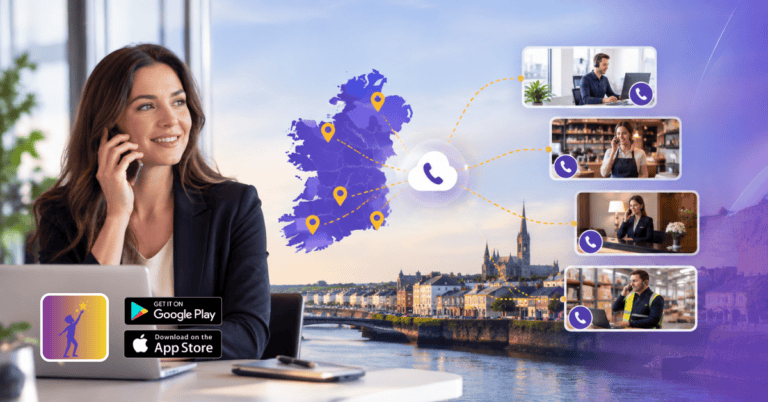
You get a dedicated Irish landline number (Dublin 01, Cork 021, or any local code) that rings across your whole team. Customers call one number and it routes intelligently — to whoever’s available, to a queue, or to a voicemail that gets emailed to you.
Calls on Any Device
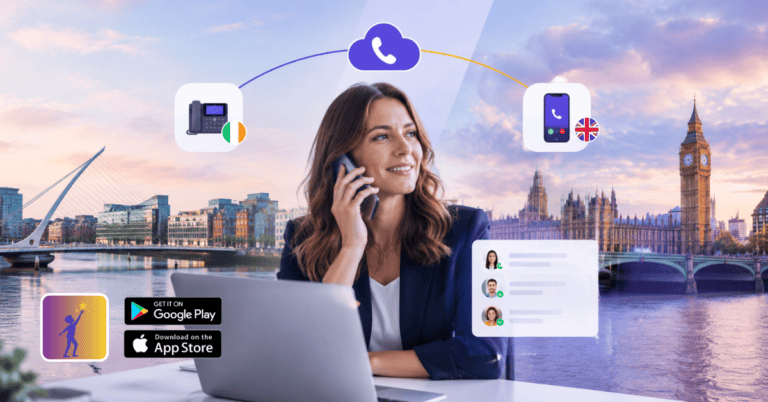
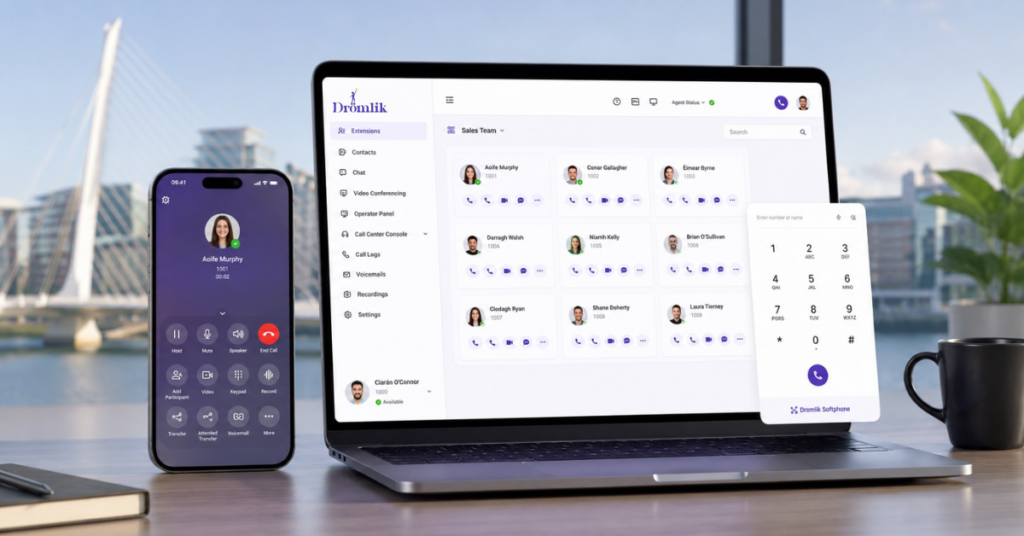
Your team answers calls on their mobiles, laptops, or desktops using an app. No desk phones required, though you can use them if you want. Works whether you’re in the office, on site, or working from home.
Smart Call Routing
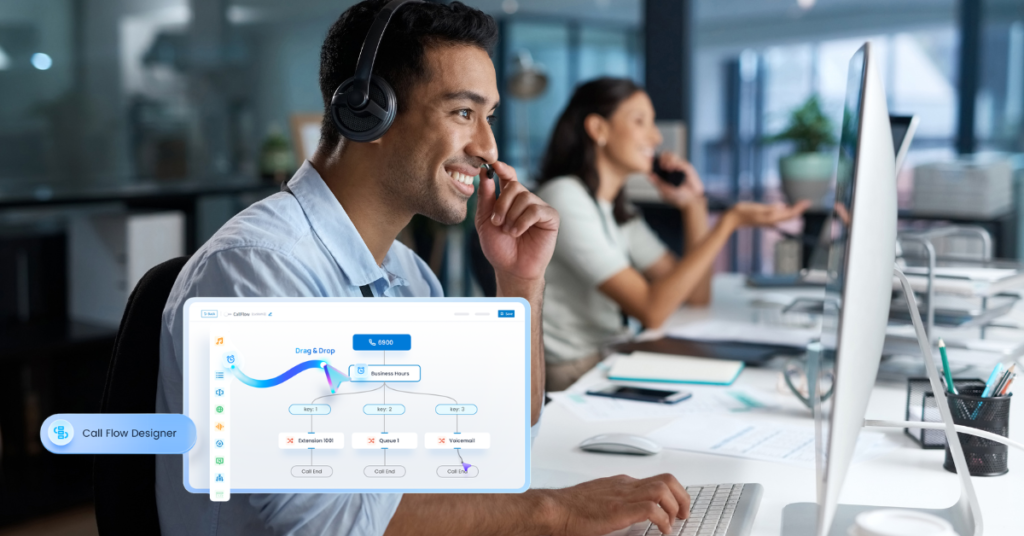
You set rules for how calls are handled: which team member gets them first, what happens if they don’t answer, what happens outside business hours. This is usually set up once and then runs automatically.
Call Recording and Analytics
Every call is logged. You can see who called, when, how long the call lasted, whether it was answered or missed. You can listen back to recordings. For businesses that rely on calls to win jobs or close sales, this is genuinely useful.
Omnichannel Messaging
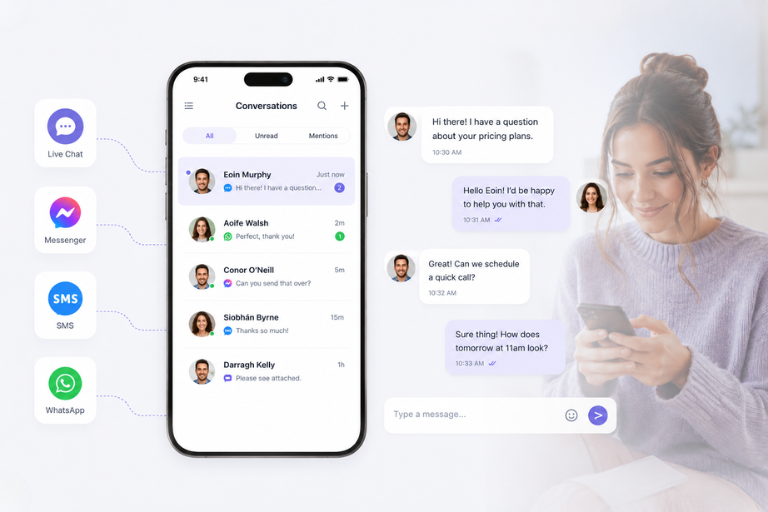
Better systems also handle SMS, WhatsApp, and chat from the same inbox as your calls. Customers can reach you however they prefer, and your team sees everything in one place.
What to Look for When Comparing Providers
Not all business phone systems are the same. Here’s what matters for an Irish SMB:
- Irish numbers and free porting. You should be able to get a local Irish number and port your existing numbers at no cost. If a provider charges for porting, walk away.
- No long-term lock-in. The best providers offer monthly or annual rolling plans. Avoid anything that traps you before you’ve had a chance to test the product properly.
- A mobile app that actually works. Your team will use the mobile app more than anything else. Ask to trial it before committing.
- Local support. If something breaks, you want to talk to someone who can help quickly. Check response time commitments before you sign up.
- GDPR compliance. Your call data should be stored within the EU. Ask explicitly where data is hosted.
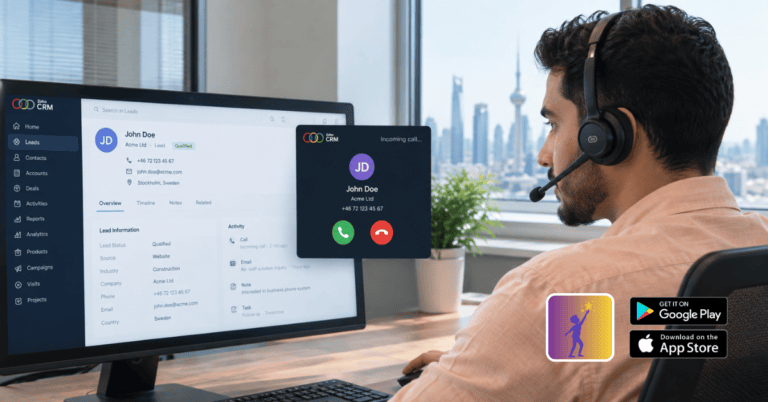
- CRM integration. If you use HubSpot, Salesforce, Zoho, or Zendesk, your phone system should connect to it. Automatic call logging alone saves hours every week.
Do You Need an AI Receptionist?
AI call handling has moved fast in the last two years. For Irish SMBs, it’s now genuinely useful — not just a gimmick.
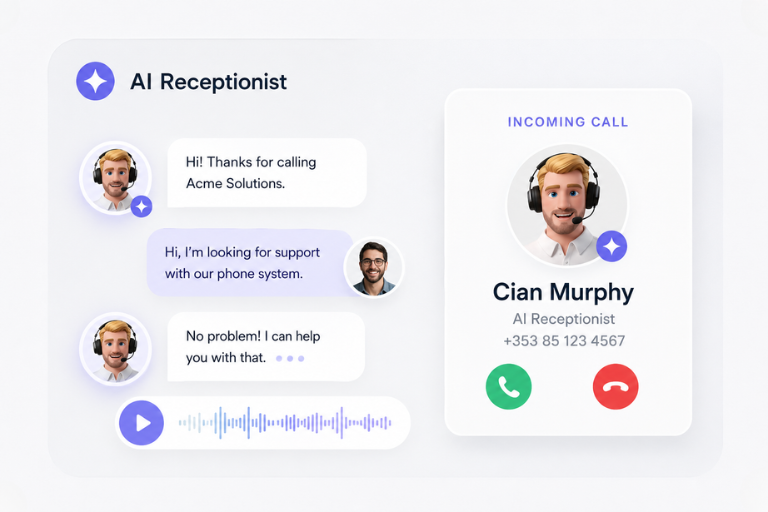
An AI receptionist answers calls when your team can’t, captures the caller’s name and reason for calling, and sends you a summary. It can qualify enquiries, handle common questions, and route urgent calls to a real person. No call goes completely unanswered, even at midnight.
It’s particularly valuable for:
- Trades and construction businesses where staff are often on site and can’t pick up
- Restaurants and hospitality businesses that get high call volumes during service hours
- Financial services firms that receive enquiries outside business hours
It’s not a replacement for your team. It’s a first line of defence that ensures no enquiry falls through the cracks.
Call Dromlik’s AI receptionist demo line on +353 1 263 4204 — it’s a live demo scenario so you hear exactly what your callers would experience.
How Much Does a Business Phone System Cost in Ireland?
Here’s what Dromlik charges, so you have a concrete benchmark:
| Plan | Price | Best For |
|---|---|---|
| Nucleus | €12/user/month | Core calling, routing, voicemail, IVR — everything most businesses need |
| Orbit | €22/user/month | Omnichannel (calls, chat, SMS, WhatsApp, FB), CRM integration, call centre features |
| AI Receptionist | +€100/month add-on | 24/7 automated call answering, 200 minutes included |
Annual billing saves around 20% on both plans.
Nucleus: €120/month. Orbit: €220/month. Add the AI Receptionist and you’re at €320/month for a fully capable setup that handles calls around the clock. For most businesses, that’s recovered by converting two or three extra enquiries a month that would otherwise have gone unanswered.
See the full pricing breakdown at dromlik.ie/pricing.
Start your free 7-day trial
No setup fees. Free number porting. Cancel anytime.
How to Switch Without Disruption
The most common concern we hear: “We’ve had our number for 15 years. We can’t lose it.”
You won’t. Number porting is included free with Dromlik, and our team manages the process for you. In Ireland, porting typically takes 5–10 business days. During that window, your existing number keeps working — there’s no gap in service.
The migration process is straightforward for most 5–50 person businesses, and we handle the technical side so your team doesn’t need to.
The Bottom Line
If your business relies on the phone — to take orders, book jobs, answer client queries, or close sales — then a proper phone system isn’t a nice-to-have. It’s basic infrastructure.
The good news is that modern cloud systems are significantly cheaper, easier to set up, and more capable than the legacy hardware-based systems that used to dominate the market. For most Irish SMBs, switching is a straightforward decision.
The harder question is which provider to go with. Trial before you commit. Check that Irish numbers and free porting are included. Make sure the mobile app works the way your team actually works.
See Dromlik in action
Dromlik offers a free trial with no setup fees and free number porting. Book a demo at dromlik.ie/book-a-demo or call us directly on 01 686 6414.